

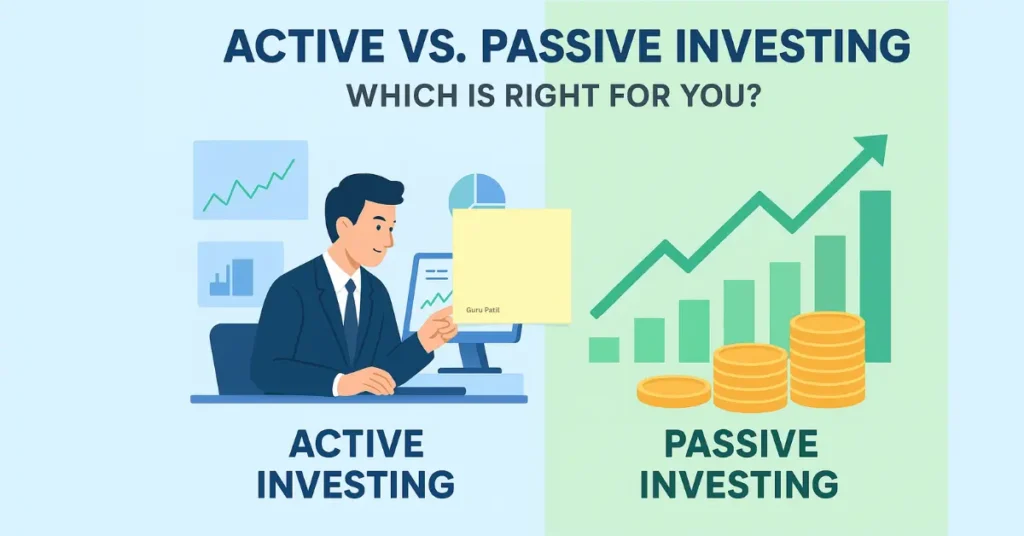
Active vs. Passive Investing: When you start your investment journey, one of the most important decisions you’ll make is choosing the right investment strategy. Should you actively try to beat the market, or should you simply follow it through low-cost index funds? Understanding the difference between active investing and passive investing is essential for anyone aiming to build wealth over time. In today’s world, where financial markets are more accessible than ever, selecting the right approach can help you achieve your financial goals faster and with greater confidence.
Both strategies aim to grow your portfolio, but they take very different paths. Some investors love the thrill of analyzing stocks and making smart moves in the market. Others prefer a simpler, long-term approach with low fees and less stress. So, the big question is: Active vs. Passive Investing — Which is right for you? Let’s break it down in a clear and simple way.
📌 What Is Active Investing?
Active investing means actively managing your investments to outperform the market. Investors or fund managers constantly study market trends, financial reports, breaking news, and real-time price changes to decide when to buy or sell.
🔹 Key Characteristics of Active Investing
- Frequent buying and selling of stocks or assets
- Involves fund managers or experienced investors
- Focuses on short-term market opportunities
- Aims to beat benchmark indexes like S&P 500 or Nifty 50
⭐ Advantages of Active Investing
- Potential for higher returns than the general market
- Can quickly adjust to market changes
- Professional analysts support decisions in actively managed funds
- More flexibility in choosing specific sectors or companies
⚠️ Disadvantages of Active Investing
- Higher fees due to management + trading costs
- Increased risk if predictions fail
- Requires time, knowledge, and emotional discipline
- Performance varies with market conditions
Active investors believe that smart decisions and timing can generate greater profits than simply following the market.
📌 What Is Passive Investing?
Passive investing is a long-term investment strategy. Instead of trying to beat the market, investors invest in index funds or ETFs that track major market indexes.
Examples:
- Nifty 50 Index Funds (India)
- S&P 500 ETFs (USA)
The main goal? Steady long-term returns with lower risk and lower costs.
🔹 Key Characteristics of Passive Investing
- Minimal trading activity
- Buy-and-hold approach
- Lower management fees
- More stable and predictable growth
⭐ Advantages of Passive Investing
- Low cost, low taxes, and fewer fees
- Reduces risk compared to active strategies
- Proven long-term performance in global markets
- Less stress — no need to monitor markets daily
⚠️ Disadvantages of Passive Investing
- Cannot beat the market — only matches performance
- Less flexibility in downturns
- Limited control over holdings
Passive investing works on the belief that markets generally rise over time, so staying invested is the key to growing wealth.
📊 Active vs. Passive Investing: A Simple Comparison
| Factor | Active Investing | Passive Investing |
|---|---|---|
| Main Goal | Beat the market | Match the market |
| Risk Level | Higher | Lower |
| Cost / Fees | High | Low |
| Strategy | Short-term trades | Long-term holding |
| Expertise Needed | Advanced | Beginner-friendly |
| Stress Level | High | Low |
| Tax Impact | Higher capital gains | Lower tax impact |
This comparison shows that both strategies have strengths — it just depends on what kind of investor you are.
🧠 Which Type of Investor Are You?
To decide between active vs. passive investing, think about your financial personality:
Choose Active Investing if:
✔ You enjoy analyzing markets and taking calculated risks
✔ You have time to monitor stocks and news
✔ You want higher returns and can accept losses
✔ You prefer working with fund managers or experts
Choose Passive Investing if:
✔ You want a simple and stress-free investment plan
✔ You believe in long-term growth
✔ You want lower fees and slow-but-steady returns
✔ You don’t have time to track the market daily
🏆 Can You Combine Active and Passive Investing?
Absolutely! Many smart investors use a hybrid investment strategy, mixing both:
- Passive investing for the core portfolio
→ Provides stability, long-term growth, and low cost - Active investing for a smaller portion
→ Gives a chance to outperform the market
This balanced method helps reduce risk while still offering growth potential.
🎯 Important Factors to Consider Before You Decide
Before choosing your strategy, think about:
1️⃣ Financial Goals
Are you saving for retirement, a house, or short-term gains?
2️⃣ Risk Tolerance
How much loss can you handle without panic?
3️⃣ Investment Timeline
Longer timelines often benefit from passive strategies.
4️⃣ Knowledge & Experience
Beginners usually start with passive investing.
5️⃣ Budget for Fees
High fees can reduce profit over time — especially in active investing.
📈 What Do Experts Say?
Most financial experts recommend passive investing for long-term wealth creation.
Even top investors like Warren Buffett support index funds for everyday people.
However, professional traders, hedge funds, and skilled investors may thrive using active strategies — when done wisely.
The truth is:
👉 Beating the market is very difficult, even for experts
👉 But staying invested long enough allows wealth to grow
🔍 SEO Keywords Used in Article
(For ranking and optimization)
- Active vs. Passive Investing
- What is Active Investing
- What is Passive Investing
- Active investing vs Passive investing comparison
- Investment strategies for beginners
- Long-term investing
- Index funds vs actively managed funds
- Best investment strategy
- Passive investment benefits
- High-risk vs low-risk investing
These keywords are naturally placed to ensure SEO friendliness without keyword stuffing.
📝 Final Thoughts
There is no universal answer to the question:
Active vs. Passive Investing — Which is right for you?
The best approach depends on:
- Your time commitment
- Your financial knowledge
- Your risk appetite
- Your investment goals
If you want a safer, long-term path with fewer fees and less stress, passive investing is usually the better option.
But if you have the skills, courage, and resources to take calculated risks, active investing may give higher rewards.
The smartest choice for many investors?
👉 Mix both strategies to build a strong and profitable investment portfolio.
Invest wisely, stay patient, and let your money work for you! 🚀💰
Also read: The Power of Compounding: How Wealth Grows Over Time