
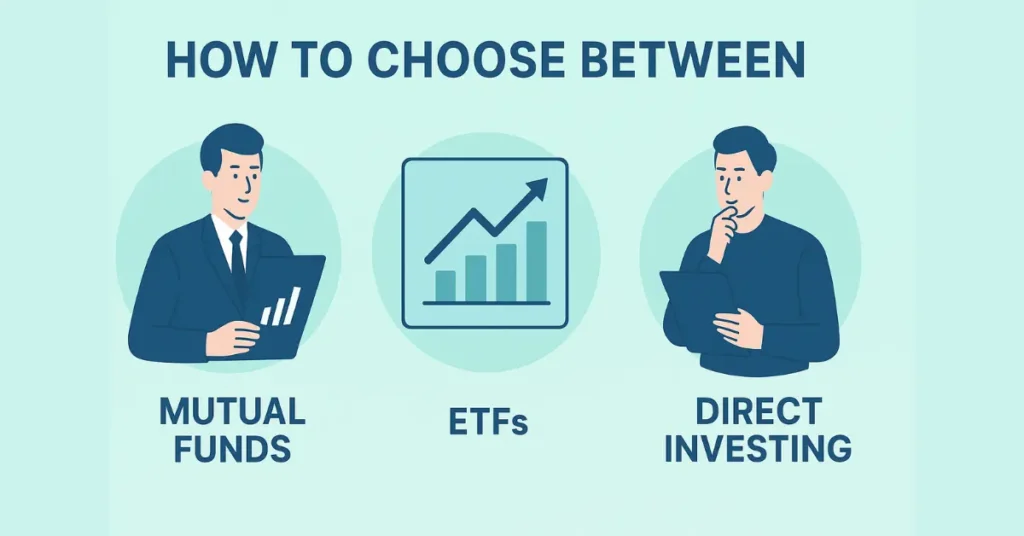
How to Choose Between Mutual Funds, ETFs, and Direct InvestingChoosing where to invest your money is one of the most important financial decisions you’ll ever make. With so many options—Mutual Funds, ETFs, and Direct Investing—it’s easy to feel confused or overwhelmed. Each option has its own benefits, risks, and ideal use cases. Understanding how these investment tools work can help you build long-term wealth with confidence, reduce financial stress, and align your money with your future goals. Whether you’re a beginner or an experienced investor looking to diversify, this guide will help you make a smart, informed choice.
What Are Mutual Funds, ETFs, and Direct Investing?
Before comparing them, let’s understand each one clearly.
1. Mutual Funds
A mutual fund pools money from many investors and invests it into assets like stocks, bonds, and gold. A professional fund manager controls buying and selling decisions.
Common types: Equity mutual funds, debt mutual funds, hybrid funds, index funds.
2. ETFs (Exchange-Traded Funds)
An ETF is also a basket of securities, but it trades on a stock exchange like a stock. Prices change throughout the day.
Popular types include index ETFs, gold ETFs, sector ETFs, and bond ETFs.
3. Direct Investing
Direct investing means you buy individual stocks, bonds, or other assets by yourself. You take full control of selection, timing, research, and portfolio management.
Why Choosing the Right Method Matters
Picking the wrong investment method can lead to:
- Higher fees
- Lower returns
- Increased risk
- Lack of diversification
- Financial stress
But choosing correctly can help you:
- Grow wealth faster
- Control risk smartly
- Match your goals with the right strategy
- Build a balanced, long-term portfolio
This is why comparison between mutual funds vs ETFs vs direct investing is critical.
Mutual Funds vs ETFs vs Direct Investing: Key Differences
1. Management Style
- Mutual Funds: Actively or passively managed
- ETFs: Mostly passive
- Direct Investing: Fully self-managed
2. Cost & Expense Ratio
- Mutual Funds: Higher cost due to fund managers
- ETFs: Lower expense ratio
- Direct Investing: No management cost, but brokerage fees apply
3. Liquidity
- Mutual Funds: Buy/sell at day’s end NAV
- ETFs: Trade instantly on exchange
- Direct Investing: High liquidity depending on stock
4. Risk
- Mutual Funds: Lower risk due to diversification
- ETFs: Moderate risk
- Direct Investing: Higher risk if portfolio is not diversified
5. Ideal For
- Mutual Funds: Beginners, long-term investors
- ETFs: Cost-conscious investors
- Direct Investing: Experienced investors
Pros and Cons of Each Investment Style
Mutual Funds: Pros
✔ Professional management
✔ Diversified portfolio
✔ SIP option for disciplined investing
✔ Great for beginners
✔ Long-term wealth creation
Mutual Funds: Cons
✘ Higher fees (expense ratio)
✘ No intraday trading
✘ Fund manager bias
ETFs: Pros
✔ Low expense ratio
✔ Transparent holdings
✔ Suitable for passive investors
✔ Traded like stocks
✔ Good for asset classes like gold & bonds
ETFs: Cons
✘ Requires Demat account
✘ Intraday volatility
✘ Limited active fund options
Direct Investing: Pros
✔ Full control
✔ No fund manager cost
✔ Potential for very high returns
✔ Build your own strategy
Direct Investing: Cons
✘ Needs deep market research
✘ High emotional risk
✘ Time-consuming
✘ No built-in diversification
Factors to Consider When Choosing Between Mutual Funds, ETFs, and Direct Investing
1. Your Investment Goal
- Short-term (1–3 years): Debt mutual funds, bond ETFs
- Medium-term (3–5 years): Hybrid mutual funds, balanced ETFs
- Long-term (5+ years): Equity mutual funds, equity ETFs, direct stocks
2. Your Risk Tolerance
- Low risk: Liquid funds, debt funds, bond ETFs
- Moderate risk: Index funds, Nifty ETFs, hybrid funds
- High risk: Direct stocks, small-cap funds, thematic ETFs
3. Your Time & Knowledge
If you don’t have time to analyze the market, mutual funds and ETFs are better.
If you enjoy research and analysis, direct stock investing fits well.
4. Cost Matters
If low cost is your priority:
→ ETFs are the cheapest option.
If you prefer hands-off investing:
→ Mutual funds justify their cost.
If you want maximum control:
→ Direct investing works best.
Which One Should You Choose? A Simple Guide
Choose Mutual Funds If…
- You’re a beginner
- You want stable long-term growth
- You prefer professionals handling your money
- You want diversification without complexity
Choose ETFs If…
- You want low-cost investing
- You want to track an index or gold
- You trade using a Demat account
- You prefer transparency and intraday trading
Choose Direct Investing If…
- You understand stock market trends
- You can analyze company fundamentals
- You want higher returns with higher risk
- You like full control on your portfolio
Can You Combine All Three? Yes!
In fact, the best strategy for long-term wealth creation is to combine:
- Mutual Funds (for stability + SIP discipline)
- ETFs (for low cost diversification)
- Direct Stocks (for high-growth potential)
This helps create a balanced portfolio that grows steadily while minimizing risk.
Example Portfolio Mix for Beginners
Here is a simple example:
- 60% Mutual Funds
- 40% Equity Fund
- 20% Debt Fund
- 20% ETFs
- 10% Index ETF
- 10% Gold ETF
- 20% Direct Stocks
- Large and mid-cap companies
This gives you growth, stability, and control.
SEO Keywords Used Naturally in the Article
- How to choose between mutual funds ETFs and direct investing
- mutual funds vs ETFs
- direct investing guide
- ETF vs mutual fund comparison
- best investment option
- long-term investing strategy
- low-cost investing
- what is direct investing
- mutual fund benefits
- ETF advantages
- investment portfolio diversification
Final Thoughts
Choosing between mutual funds, ETFs, and direct investing doesn’t have to be complicated. Start by understanding your goals, risk tolerance, and knowledge level. Mutual funds offer simplicity, ETFs offer low cost, and direct investing offers total control. There’s no “one best option”—the smart move is to pick what aligns with your financial journey. With the right mix, you can build a strong, diversified, and profitable portfolio for the future.
Also read: The Difference Between Investing and Trading: A Complete Guide