

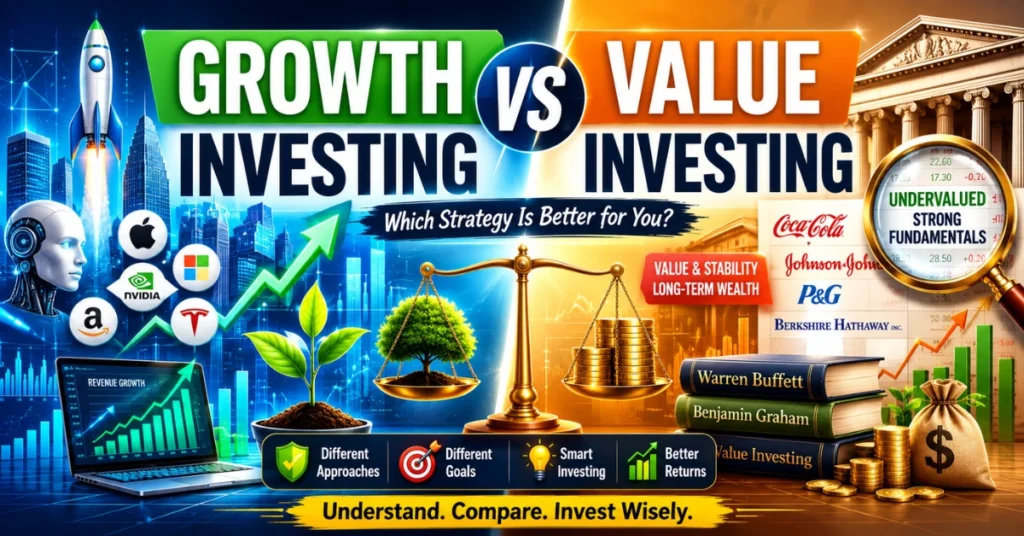
Investing in the stock market can help people grow wealth over time, but choosing the right investment strategy is very important. Two of the most popular approaches are growth investing and value investing. Both strategies have created successful investors and generated strong returns over the years. However, they work in very different ways.
Some investors prefer fast-growing companies with high future potential, while others look for undervalued stocks trading below their real worth. Understanding the difference between growth investing and value investing can help investors make smarter financial decisions and build a balanced portfolio.
In this guide, we will explain growth investing vs value investing in simple terms, compare their advantages and disadvantages, and help you decide which strategy may fit your financial goals.
What Is Growth Investing?
Growth investing is an investment strategy focused on companies that are expected to grow faster than the overall market. These companies usually increase their revenue, earnings, and market share quickly.
Growth investors are willing to pay a higher price for stocks because they believe the company’s future profits will be much larger.
Technology companies are often considered growth stocks because they innovate rapidly and expand aggressively.
Characteristics of Growth Stocks
- High revenue and earnings growth
- Strong future potential
- Often trade at high price-to-earnings (P/E) ratios
- Usually reinvest profits instead of paying dividends
- Popular in sectors like technology, healthcare, and AI
Examples of Growth Companies
Some well-known growth companies include:
- Apple
- Amazon
- Tesla
- NVIDIA
These companies became popular because investors believed their future earnings would continue growing rapidly.
Advantages of Growth Investing
1. High Return Potential
Growth stocks can generate massive returns when companies expand successfully. Early investors in major technology companies earned huge profits over time.
2. Capital Appreciation
Growth investors focus mainly on stock price appreciation rather than dividend income. If the company performs well, stock prices may rise significantly.
3. Innovation Opportunities
Growth investing allows investors to participate in innovative industries such as artificial intelligence, electric vehicles, cloud computing, and biotechnology.
Disadvantages of Growth Investing
1. Higher Risk
Growth stocks are usually more volatile. If company earnings disappoint investors, stock prices may fall sharply.
2. Expensive Valuations
Many growth stocks trade at high valuations. Investors often pay a premium price based on future expectations.
3. Limited Dividends
Most growth companies reinvest profits back into the business instead of paying dividends to shareholders.
What Is Value Investing?
Value investing is an investment strategy where investors buy stocks that appear undervalued compared to their intrinsic value. These companies may be temporarily ignored by the market, but they often have strong fundamentals.
Value investors believe the market sometimes misprices stocks, creating opportunities to buy quality companies at discounted prices.
This strategy became famous through legendary investor Benjamin Graham and was later popularized by Warren Buffett.
Characteristics of Value Stocks
- Lower price-to-earnings (P/E) ratios
- Stable business models
- Strong financial fundamentals
- Often pay regular dividends
- Usually found in mature industries
Examples of Value Companies
Examples of value-oriented companies include:
- Coca-Cola
- Johnson & Johnson
- Procter & Gamble
- Bank of America
These companies are often considered stable businesses with consistent earnings.
Advantages of Value Investing
1. Lower Risk
Value stocks are generally more stable than growth stocks because they are often established businesses with predictable income.
2. Dividend Income
Many value companies pay regular dividends, providing investors with passive income.
3. Margin of Safety
Buying undervalued stocks may reduce downside risk because investors purchase shares below their estimated intrinsic value.
Disadvantages of Value Investing
1. Slower Growth
Value stocks may not deliver explosive returns like growth stocks.
2. Requires Patience
Undervalued stocks can remain cheap for a long time before the market recognizes their true value.
3. Value Traps
Some stocks appear cheap because the company is facing long-term problems. Investors must carefully research before investing.
Growth Investing vs Value Investing: Key Differences
| Feature | Growth Investing | Value Investing |
|---|---|---|
| Main Goal | Capital growth | Buying undervalued stocks |
| Risk Level | Higher | Moderate |
| Dividend Payments | Usually low or none | Often regular dividends |
| Stock Valuation | Expensive | Relatively cheap |
| Investor Focus | Future growth | Current intrinsic value |
| Common Sectors | Technology, AI | Banking, consumer goods |
| Investment Style | Aggressive | Conservative |
Which Strategy Performs Better?
There is no single answer because market conditions change over time.
- Growth investing often performs better during strong economic expansion and low interest rates.
- Value investing may outperform during market corrections or uncertain economic conditions.
Historically, both strategies have experienced periods of success.
For example:
- During technology booms, growth stocks often lead the market.
- During economic slowdowns, value stocks may provide more stability.
Many professional investors combine both strategies to reduce risk and improve diversification.
Growth Investing vs Value Investing: Which Is Better for Beginners?
The best strategy depends on your financial goals, risk tolerance, and investment timeline.
Growth Investing May Be Better If:
- You are comfortable with higher risk
- You want long-term capital appreciation
- You are interested in innovative industries
- You can handle market volatility
Value Investing May Be Better If:
- You prefer stable investments
- You want dividend income
- You are a conservative investor
- You focus on long-term wealth preservation
Can You Combine Growth and Value Investing?
Yes, many investors use a blended investment strategy.
Combining growth and value stocks can help balance risk and reward. Growth stocks may provide higher returns, while value stocks may add stability and dividend income.
A diversified portfolio often includes:
- Large-cap growth stocks
- Dividend-paying value stocks
- Index funds
- International investments
This approach may help investors handle different market conditions more effectively.
Important Metrics Used in Both Strategies
Investors use several financial metrics to evaluate stocks.
Common Growth Investing Metrics
- Revenue growth
- Earnings growth
- Market share expansion
- Price-to-sales ratio
- Future earnings estimates
Common Value Investing Metrics
- Price-to-earnings (P/E) ratio
- Price-to-book (P/B) ratio
- Dividend yield
- Free cash flow
- Intrinsic value analysis
Understanding these metrics can help investors make informed decisions.
Famous Investors Associated With Each Strategy
Growth Investors
- Peter Lynch
- Cathie Wood
Value Investors
- Warren Buffett
- Benjamin Graham
- Charlie Munger
Their investment philosophies continue to influence investors worldwide.
Tips for Choosing the Right Investment Strategy
1. Understand Your Risk Tolerance
Growth investing can be more volatile, while value investing is often more stable.
2. Define Your Financial Goals
Choose a strategy based on whether you want aggressive growth or steady income.
3. Diversify Your Portfolio
Avoid investing all your money in one type of stock or sector.
4. Invest for the Long Term
Both growth and value investing work best with patience and long-term thinking.
5. Continue Learning
Study company financials, market trends, and economic conditions regularly.
Final Thoughts
The debate between growth investing vs value investing has existed for decades, and both strategies offer unique benefits. Growth investing focuses on companies with strong future potential, while value investing aims to find undervalued stocks trading below their true worth.
Neither strategy is perfect for every investor. Growth investing may deliver higher returns but comes with greater volatility. Value investing offers stability and income but may require patience.
The best approach often depends on your investment goals, time horizon, and risk tolerance. Many successful investors combine both strategies to create a balanced portfolio that performs well in different market environments.
Whether you choose growth investing, value investing, or a mix of both, staying disciplined and investing consistently can help build long-term wealth.
Also read : What is Value Investing?


