

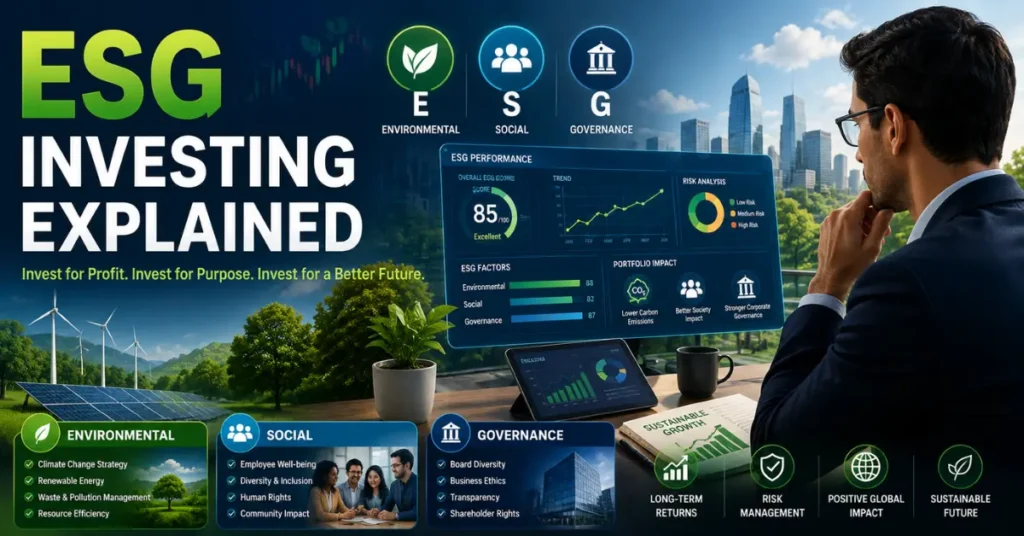
In today’s investment world, making money is no longer the only goal for many investors. People are increasingly interested in investing in companies that care about the environment, treat employees fairly, and follow ethical business practices. This approach is known as ESG investing. It allows investors to align their financial goals with their personal values while potentially generating long-term returns. As sustainability becomes more important worldwide, ESG investing has gained significant attention from individuals, businesses, and financial institutions alike.
What Is ESG Investing?
ESG investing stands for Environmental, Social, and Governance investing. It is an investment strategy that evaluates companies based not only on financial performance but also on how they manage environmental, social, and governance factors.
The three components of ESG are:
Environmental (E)
The environmental aspect focuses on how a company impacts the natural environment. Investors look at factors such as:
- Carbon emissions
- Climate change policies
- Renewable energy usage
- Waste management
- Water conservation
- Pollution control
Companies that actively work to reduce their environmental footprint often receive higher ESG ratings.
Social (S)
The social factor examines how a company interacts with employees, customers, suppliers, and communities. Important considerations include:
- Employee welfare
- Workplace diversity and inclusion
- Human rights practices
- Customer satisfaction
- Data privacy and security
- Community involvement
Businesses with strong social responsibility tend to build better reputations and stronger customer loyalty.
Governance (G)
Governance refers to how a company is managed and controlled. Investors evaluate:
- Board diversity
- Executive compensation
- Business ethics
- Transparency
- Shareholder rights
- Anti-corruption policies
Good governance practices can help companies avoid scandals and improve long-term stability.
Why ESG Investing Matters
ESG investing has become increasingly important because investors recognize that environmental, social, and governance issues can directly affect a company’s financial performance.
For example:
- Climate-related risks can impact business operations.
- Poor labor practices can damage brand reputation.
- Weak governance can lead to legal and financial problems.
By considering ESG factors, investors can identify companies that may be better positioned for long-term success.
How ESG Investing Works
ESG investors use various methods to evaluate investment opportunities.
ESG Screening
Investors may exclude companies involved in industries such as:
- Tobacco
- Weapons manufacturing
- Gambling
- Fossil fuels
This process is known as negative screening.
Positive Screening
Investors actively seek companies with strong ESG performance. These businesses often demonstrate leadership in sustainability, diversity, and ethical governance.
ESG Ratings
Specialized agencies provide ESG scores and ratings based on company performance. These ratings help investors compare businesses and make informed decisions.
ESG Funds and ETFs
Many investors choose ESG mutual funds or ESG exchange-traded funds (ETFs). These investment products contain companies that meet specific environmental, social, and governance criteria.
Benefits of ESG Investing
1. Supports Sustainable Development
ESG investing encourages businesses to adopt responsible practices that benefit society and the environment.
2. Potential Long-Term Growth
Companies with strong ESG practices often focus on risk management, innovation, and sustainability, which may contribute to long-term growth.
3. Risk Reduction
Environmental disasters, labor disputes, and governance scandals can negatively affect company performance. ESG analysis helps identify such risks early.
4. Aligns Investments With Personal Values
Many investors want their money to support companies that reflect their beliefs regarding sustainability, social responsibility, and ethical business conduct.
5. Increasing Market Demand
Demand for sustainable investing continues to grow globally, leading to more ESG-focused investment opportunities.
Risks and Challenges of ESG Investing
Although ESG investing offers many advantages, it also presents certain challenges.
Lack of Standardization
Different ESG rating agencies may use different methodologies, leading to inconsistent scores for the same company.
Greenwashing
Some companies may exaggerate their sustainability efforts to attract investors. This practice is known as greenwashing.
Limited Historical Data
ESG investing is still evolving, and long-term performance data may be limited compared to traditional investing strategies.
Potential Sector Exclusions
Avoiding certain industries can reduce diversification opportunities within a portfolio.
ESG Investing vs Traditional Investing
Traditional investing primarily focuses on financial metrics such as:
- Revenue growth
- Profit margins
- Earnings per share
- Market share
ESG investing adds another layer of analysis by considering environmental, social, and governance factors.
While traditional investors may focus solely on profitability, ESG investors evaluate both financial performance and corporate responsibility.
Popular ESG Investment Options
Investors have several ways to participate in ESG investing.
ESG Mutual Funds
Professional fund managers select companies that meet ESG criteria and manage the portfolio on behalf of investors.
ESG ETFs
ESG exchange-traded funds offer a diversified collection of ESG-focused companies and can be traded like stocks.
Individual ESG Stocks
Investors can directly purchase shares of companies known for strong ESG performance.
Green Bonds
Green bonds help finance environmentally friendly projects such as renewable energy, clean transportation, and sustainable infrastructure.
How to Start ESG Investing
If you are new to ESG investing, follow these steps:
Define Your Goals
Determine whether your primary objective is sustainability, financial growth, or a combination of both.
Research ESG Ratings
Review ESG ratings and sustainability reports to understand how companies perform.
Choose the Right Investment Vehicle
Select ESG mutual funds, ESG ETFs, individual stocks, or green bonds based on your investment goals.
Diversify Your Portfolio
Maintain diversification across industries and asset classes to manage risk.
Monitor Performance
Regularly review both financial results and ESG developments affecting your investments.
ESG Investing Trends in 2026 and Beyond
The future of ESG investing looks promising. Several trends are shaping the industry:
Increased Regulatory Oversight
Governments and regulators are introducing stricter disclosure requirements regarding ESG practices.
Greater Corporate Transparency
Companies are providing more detailed sustainability reports and ESG data.
Climate-Focused Investments
Investments in renewable energy, electric vehicles, and clean technology continue to grow.
Technology-Driven ESG Analysis
Artificial intelligence and advanced analytics are helping investors assess ESG performance more accurately.
Growing Investor Awareness
Younger generations are increasingly prioritizing sustainability and responsible investing.
Common ESG Investing Myths
Myth 1: ESG Investing Sacrifices Returns
Many studies suggest that companies with strong ESG practices can deliver competitive long-term performance.
Myth 2: ESG Investing Is Only About the Environment
ESG includes environmental, social, and governance factors, making it much broader than environmental concerns alone.
Myth 3: ESG Investing Is Only for Large Investors
Today, individual investors can access ESG funds, ETFs, and investment platforms with relatively small amounts of capital.
Conclusion
ESG investing is transforming the way people think about wealth creation and corporate responsibility. By considering environmental, social, and governance factors alongside traditional financial metrics, investors can make more informed decisions that align with both their values and financial objectives.
As sustainability continues to influence global markets, ESG investing is expected to play an even larger role in portfolio management. Whether you are a beginner or an experienced investor, understanding ESG principles can help you build a more responsible and potentially resilient investment portfolio for the future.
Investing with an ESG approach is not just about earning returns—it is about supporting businesses that contribute positively to society, protect the environment, and maintain strong governance standards.
Also read : What are Index Funds and Why They Matter