

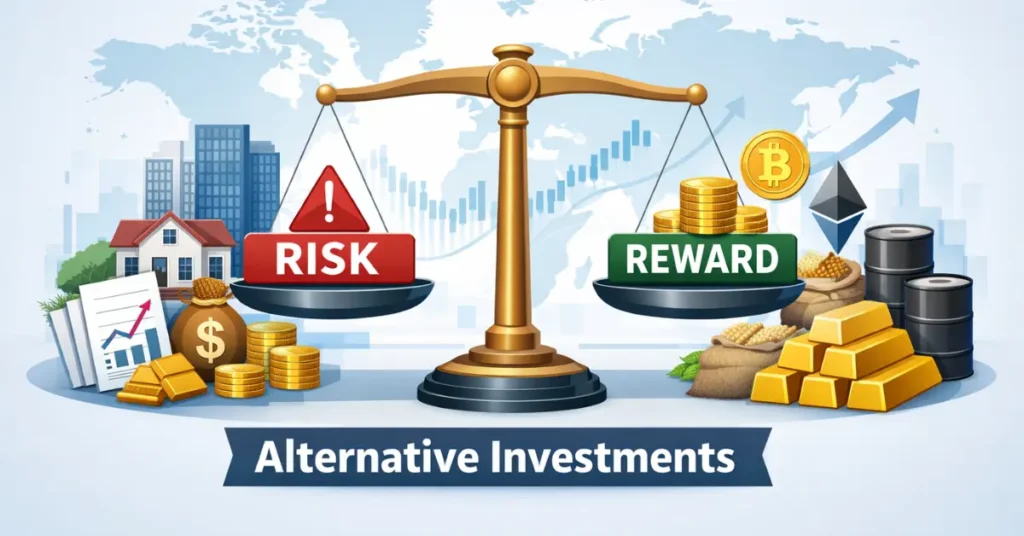
Alternative Investment:In today’s fast-changing financial world, investors are no longer satisfied with traditional options like fixed deposits, bonds, or mutual funds alone. With rising inflation, market volatility, and evolving global economies, people are actively looking for smarter ways to grow and protect their wealth. This is where alternative investments come into the picture. Understanding the balance between risk and reward in the alternative investment landscape is essential for making informed financial decisions. Whether you are a beginner investor or someone looking to diversify your portfolio, knowing how these investments work can help you unlock new growth opportunities while managing potential risks.
What Are Alternative Investments?
Alternative investments are financial assets that fall outside traditional categories such as stocks, bonds, and cash. These investments often behave differently from conventional markets, which makes them attractive for diversification.
Common types of alternative investments include:
- Real estate
- Private equity
- Hedge funds
- Commodities
- Cryptocurrencies and digital assets
- Venture capital
- Collectibles (art, wine, rare coins)
Unlike traditional investments, alternative assets may have limited liquidity, higher minimum investments, and complex structures. However, they also offer the potential for higher returns and portfolio stability during market downturns.
Why Alternative Investments Are Gaining Popularity
The growing interest in alternative investments is driven by several key factors:
- Portfolio Diversification
Alternative assets often have low correlation with stock markets, helping investors reduce overall portfolio risk. - Higher Return Potential
Many alternative investments aim to generate higher returns compared to traditional assets, especially over the long term. - Inflation Protection
Assets like real estate, commodities, and infrastructure can act as a hedge against inflation. - Access to Innovation
Venture capital and private equity provide exposure to early-stage companies and disruptive technologies. - Digital Transformation
Cryptocurrencies and blockchain-based assets have opened new opportunities for global investors.
Understanding Risk in Alternative Investments
While alternative investments can be rewarding, they also come with unique risks. Understanding these risks is crucial before investing.
1. Liquidity Risk
Many alternative investments are not easily sold or converted into cash. Real estate, private equity, and hedge funds often require long lock-in periods.
2. Market Risk
Although alternatives may reduce dependence on stock markets, they are still affected by economic cycles, interest rates, and geopolitical events.
3. Regulatory Risk
Certain alternative assets, especially cryptocurrencies, face changing regulations across countries, which can impact value and adoption.
4. Valuation Risk
Unlike publicly traded stocks, alternative assets are not priced daily. This makes valuation less transparent and sometimes subjective.
5. Complexity Risk
Alternative investments often involve complex structures, strategies, and fee models that may not be suitable for all investors.
Understanding Reward in Alternative Investments
Despite the risks, alternative investments can offer attractive rewards when approached strategically.
1. Higher Long-Term Returns
Private equity, venture capital, and crypto assets have shown the potential to deliver strong long-term gains.
2. Income Generation
Real estate and infrastructure investments can generate stable rental or operational income.
3. Capital Appreciation
Assets like land, commercial property, and digital assets can significantly increase in value over time.
4. Risk-Adjusted Performance
By diversifying across asset classes, investors can improve risk-adjusted returns and reduce volatility.
5. Global Opportunities
Alternative investments provide access to global markets and emerging sectors that are not available through traditional investments.
Key Types of Alternative Investments Explained
Real Estate Investments
Real estate remains one of the most popular alternative investments. It includes residential, commercial, and industrial properties.
Risks:
- Market downturns
- Maintenance costs
- Liquidity challenges
Rewards:
- Rental income
- Long-term appreciation
- Inflation hedge
Private Equity and Venture Capital
Private equity involves investing in privately held companies, while venture capital focuses on startups and early-stage businesses.
Risks:
- Business failure
- Long investment horizon
- Limited liquidity
Rewards:
- High growth potential
- Early access to innovation
- Strong returns on successful exits
Hedge Funds
Hedge funds use advanced strategies such as leverage, derivatives, and short selling to generate returns.
Risks:
- Complex strategies
- High fees
- Market volatility
Rewards:
- Flexible investment strategies
- Potential for consistent returns
- Risk management techniques
Commodities
Commodities include gold, silver, oil, agricultural products, and metals.
Risks:
- Price fluctuations
- Supply and demand shocks
- Global events
Rewards:
- Inflation protection
- Portfolio diversification
- Safe-haven assets like gold
Cryptocurrencies and Digital Assets
Cryptocurrencies are one of the fastest-growing alternative investment options.
Risks:
- High volatility
- Regulatory uncertainty
- Cybersecurity threats
Rewards:
- High return potential
- Decentralized financial systems
- Global accessibility
How to Balance Risk and Reward Effectively
To succeed in the alternative investment landscape, investors must focus on balance rather than chasing high returns blindly.
1. Diversify Across Asset Classes
Avoid concentrating capital in a single alternative asset. Diversification reduces risk exposure.
2. Assess Your Risk Tolerance
Understand how much risk you can afford based on your financial goals, income, and investment horizon.
3. Conduct Proper Due Diligence
Research the asset, market trends, management team, and historical performance before investing.
4. Start Small
If you are new to alternative investments, begin with smaller allocations and scale gradually.
5. Seek Professional Guidance
Financial advisors can help structure alternative investment strategies aligned with your goals.
Role of Alternative Investments in a Modern Portfolio
Alternative investments are no longer limited to institutional investors or high-net-worth individuals. With digital platforms and evolving financial products, retail investors can now access these opportunities more easily.
A well-structured portfolio may include:
- Traditional assets for stability
- Alternative investments for growth
- Liquid assets for flexibility
This balanced approach helps manage downside risks while maximizing upside potential.
Common Myths About Alternative Investments
- They are only for the wealthy – Not true anymore, thanks to fractional investing and digital platforms.
- They are too risky – Risk varies by asset type and strategy.
- They guarantee high returns – No investment is risk-free; returns depend on market conditions.
Understanding facts instead of myths leads to better decision-making.
Final Thoughts
The alternative investment landscape offers exciting opportunities, but it is not without challenges. By understanding the risk and reward dynamics, investors can make smarter choices and build resilient portfolios. Whether it’s real estate, private equity, commodities, or cryptocurrencies, alternative investments can play a powerful role in long-term wealth creation when approached with knowledge and discipline.
As financial markets continue to evolve, alternative investments are likely to become an essential part of modern investing. The key is not to avoid risk completely, but to understand it, manage it, and align it with your financial goals.
By staying informed and adopting a balanced strategy, you can confidently navigate the alternative investment landscape and unlock its full potential.
Also read: Why HNIs Are Diversifying Beyond the Stock Market