

Starting a startup requires more than a great idea. Founders need capital to build products, hire teams, acquire customers, and scale their businesses. This is where startup funding rounds become important.
Among the most common venture funding stages are Seed, Series A, and Series B funding. Each stage represents a different level of business maturity and comes with different goals, investor expectations, and uses of capital.
Understanding the difference between Seed vs Series A vs Series B funding can help founders determine when to raise capital and what investors may expect at each stage.
What Are Startup Funding Stages?
Startup funding is typically raised through different financing rounds as a company develops.
A common funding journey looks like:
Seed → Series A → Series B → Series C and beyond
However, not every startup follows this exact path. Some companies bootstrap their businesses, skip funding rounds, raise multiple smaller rounds, or become profitable without raising venture capital.
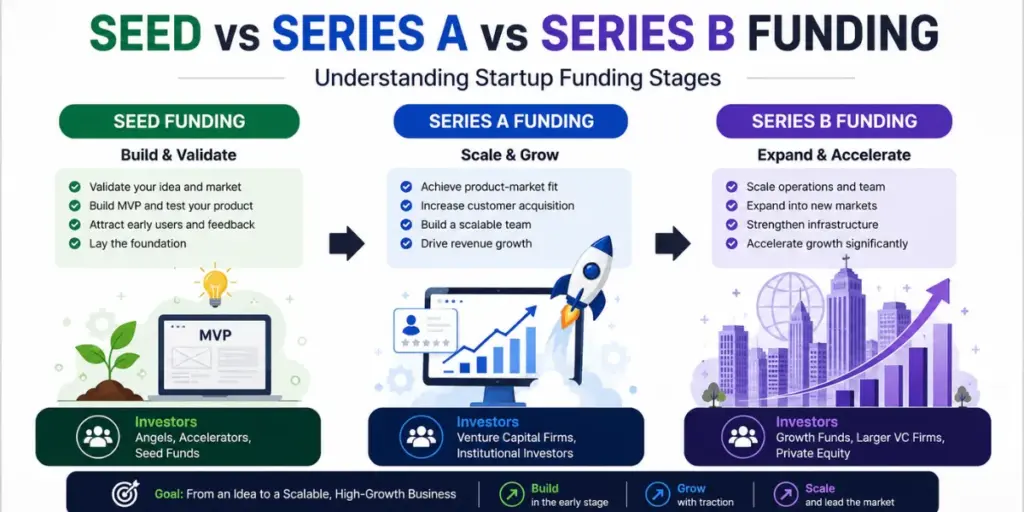
The three early-to-growth stages can be broadly understood as:
- Seed Funding: Build and validate the startup.
- Series A: Develop a scalable business and accelerate growth.
- Series B: Scale the business and expand into larger markets.
The amount raised at each stage can vary significantly depending on the company’s industry, location, valuation, traction, business model, and market conditions.
Seed vs Series A vs Series B: Quick Comparison
| Factor | Seed Funding | Series A | Series B |
|---|---|---|---|
| Main Goal | Build and validate | Scale the business model | Accelerate expansion |
| Startup Stage | Early stage | Growth stage | Expansion stage |
| Main Focus | Product and market validation | Product-market fit and growth | Market expansion and scaling |
| Typical Investors | Angels, accelerators, seed funds | Venture capital firms | Larger VC and growth investors |
| Key Evidence | Product and early traction | Strong traction and growth | Proven growth engine |
| Common Uses | Product, hiring, research | Sales, marketing, hiring | Expansion, infrastructure, hiring |
| Risk | Very high | High | Generally lower than earlier stages |
These are general guidelines. There is no universal funding amount or specific revenue level that automatically qualifies a company for a particular round.
What Is Seed Funding?
Seed funding is an early stage of startup financing used to help founders develop their product, test their business model, and establish initial traction.
At the seed stage, a startup may still be trying to answer important questions such as:
- Do customers want this product?
- Is there a real market?
- Can the product solve an important problem?
- Can the company acquire customers?
- Can the business eventually become scalable?
Seed funding provides founders with the resources needed to test these assumptions.
What Is Seed Funding Used For?
Startups commonly use seed capital for:
- Building a minimum viable product (MVP)
- Product development
- Hiring initial employees
- Customer research
- Market research
- Testing marketing channels
- Acquiring early customers
- Improving technology
- Establishing business operations
- Validating product-market fit
The exact use of funds depends on the company’s business model and development stage.
Who Invests in Seed Funding?
Seed-stage investors can include:
- Angel investors
- Seed venture capital funds
- Startup accelerators
- Family offices
- Early-stage investment firms
- Experienced entrepreneurs
Some early-stage startups also use financing instruments such as SAFEs or convertible notes, while others raise equity financing.
What Do Seed Investors Look For?
Seed investors often evaluate factors such as:
- Founder experience
- Market opportunity
- Product idea
- Early customer feedback
- Initial traction
- Technology
- Competitive advantage
- Potential for future growth
Because seed-stage startups often have limited financial history, investors may place significant importance on the founding team, market opportunity, and early signs of demand.
What Is Series A Funding?
Series A funding is generally raised after a startup has demonstrated meaningful traction and has a clearer path toward building a scalable business.
At this stage, investors are typically looking for more than just an interesting idea. They want evidence that the startup can turn its opportunity into repeatable and measurable growth.
Series A funding is often used to build the team, strengthen the product, expand customer acquisition, and establish scalable operations.
What Is Series A Funding Used For?
Common uses of Series A capital include:
- Hiring employees
- Expanding sales teams
- Increasing marketing
- Improving the product
- Developing new features
- Building technology infrastructure
- Expanding customer support
- Entering new customer segments
- Improving business operations
The objective is usually to move from early traction toward a more predictable and scalable growth model.
What Do Series A Investors Look For?
Series A investors may examine metrics such as:
- Revenue growth
- Customer growth
- Customer retention
- Product-market fit
- Customer acquisition cost
- Customer lifetime value
- Gross margins
- User engagement
- Market size
- Growth rate
The specific metrics depend on the startup.
For example, a SaaS company may focus heavily on recurring revenue and retention, while a marketplace business may emphasize transaction volume, repeat customers, and marketplace liquidity.
What Is Series B Funding?
Series B funding generally supports a startup that has already demonstrated a viable business model and is ready to accelerate growth.
At this stage, the company is often no longer focused primarily on proving whether its product works. Instead, it is focused on scaling what already works.
Series B funding can provide the capital needed to enter new markets, expand teams, increase sales, strengthen infrastructure, and develop new products.
What Is Series B Funding Used For?
Series B capital may be used for:
- Geographic expansion
- Large-scale hiring
- Sales expansion
- Marketing
- New product development
- Technology infrastructure
- Business operations
- Market expansion
- Strategic acquisitions
For example, a startup that has become successful in one country may use Series B funding to expand internationally.
Seed vs Series A vs Series B: Key Differences
1. Business Maturity
The biggest difference between these funding stages is the maturity of the company.
Seed
The startup is usually still validating its product, market, and business model.
Series A
The startup has stronger traction and is working toward repeatable and scalable growth.
Series B
The startup has demonstrated a viable growth model and wants to expand rapidly.
2. Investor Expectations
Investor expectations generally increase as the company moves through funding stages.
At the Seed stage, investors may focus heavily on the founders, market opportunity, product, and early traction.
At Series A, investors typically expect stronger evidence of product-market fit, customer demand, and growth.
At Series B, investors generally want to see a proven business model, strong growth, and a clear opportunity to scale.
3. Use of Capital
The purpose of capital also changes.
Seed: Build and validate.
Series A: Prove and scale.
Series B: Accelerate and expand.
This simple framework makes it easier to understand the difference between the three funding stages.
How Much Money Can a Startup Raise?
There is no fixed amount that defines Seed, Series A, or Series B funding.
Funding sizes can vary based on:
- Industry
- Country
- Startup valuation
- Revenue
- Growth rate
- Market opportunity
- Investor demand
- Economic conditions
- Business model
- Competitive environment
For this reason, founders should not decide that they are ready for a particular funding stage simply because they want to raise a specific amount.
Instead, they should consider what business milestone the funding will help achieve.
For example, one startup may raise seed capital to develop its product, while another may raise a larger seed round after already demonstrating significant customer demand.
How Do Startups Know When to Raise Series A?
A startup should generally consider Series A when it has enough evidence to demonstrate that its business can grow beyond the early validation stage.
Founders may ask:
- Do we have strong customer demand?
- Are revenues growing?
- Are customers returning?
- Do we have product-market fit?
- Can we acquire customers predictably?
- Is the market large enough?
- Do we have a clear growth strategy?
- Can additional capital accelerate growth?
The answers will vary by company, but investors typically want evidence that the startup has moved beyond pure experimentation.
How Do Startups Know When to Raise Series B?
Before raising Series B, founders should consider whether their existing growth engine is working.
Important questions include:
- Is our growth repeatable?
- Are sales increasing consistently?
- Can we scale our sales and marketing?
- Are unit economics improving?
- Can we enter new markets?
- Is our team prepared for rapid expansion?
- Can additional capital significantly accelerate growth?
Series B is generally about scaling a business that has already demonstrated meaningful traction.
Founder Dilution During Funding Rounds
One important consideration when raising startup funding is equity dilution.
When a company issues new shares to investors, existing shareholders may own a smaller percentage of the company.
For example, imagine a startup has 1 million shares before a funding round. If new shares are issued to investors, the founders’ percentage ownership may decrease.
However, dilution is not necessarily negative.
If new investment helps the company grow from a small startup into a highly valuable business, founders may own a smaller percentage of a much larger company.
Founders should therefore evaluate both ownership percentage and company value, along with other investment terms.
Example: Seed vs Series A vs Series B
Consider a fictional SaaS startup called CloudFlow.
Seed Stage
CloudFlow has developed its software and acquired its first customers.
The founders raise seed funding to:
- Improve the product
- Hire developers
- Test marketing
- Acquire more customers
The main goal is to validate the product and business model.
Series A
CloudFlow now has strong customer demand and growing recurring revenue.
The company raises Series A funding to:
- Hire a larger sales team
- Expand marketing
- Improve customer support
- Build new product features
- Establish scalable operations
The goal is to turn early traction into predictable growth.
Series B
CloudFlow has developed a repeatable sales and growth model.
The company raises Series B funding to:
- Enter international markets
- Expand its workforce
- Build enterprise products
- Increase sales capacity
- Scale technology infrastructure
The goal is rapid expansion.
This example demonstrates how the purpose of funding changes as the startup becomes more mature.
What Investors Look For at Each Funding Stage
Seed Investors
Seed investors may focus on:
- Founders
- Market opportunity
- Product
- Early traction
- Vision
- Potential
Series A Investors
Series A investors may focus more heavily on:
- Product-market fit
- Revenue
- Customer growth
- Retention
- Unit economics
- Customer acquisition
- Scalability
Series B Investors
Series B investors may focus on:
- Revenue scale
- Growth rate
- Market expansion
- Operational efficiency
- Competitive position
- Management team
- Scalability
The metrics investors prioritize will depend on the startup’s business model and industry.
Common Startup Fundraising Mistakes
Raising Too Early
A great idea does not automatically mean that a startup is ready for institutional funding.
Founders should have evidence that supports the funding story they are presenting to investors.
Focusing Only on Valuation
A high valuation can be attractive, but founders should also understand dilution, investor rights, liquidation preferences, governance, and other terms.
Raising Without Clear Milestones
Funding should have a clear purpose.
Founders should understand what the new capital is expected to accomplish and which milestones it should help the company reach.
Ignoring Cash Runway
Startups need to monitor how long their current capital will last.
Waiting until cash is almost exhausted can make fundraising more difficult.
Treating Every Funding Round the Same
Seed, Series A, and Series B investors can have different expectations.
The company’s fundraising story should evolve as the business grows.
Does Every Startup Need Seed, Series A and Series B?
No.
Not every startup needs to raise Seed, Series A, and Series B funding.
Some startups:
- Bootstrap their businesses
- Raise only one funding round
- Become profitable without venture capital
- Use debt financing
- Raise strategic investment
- Skip a traditional funding round
- Get acquired before reaching Series B
The best financing strategy depends on the company’s business model, growth objectives, capital requirements, and founders’ goals.
Seed vs Series A vs Series B: Which Funding Stage Is Right?
A simple way to understand the three stages is:
Need to build and validate the business? → Seed Funding
Have traction and need to build scalable growth? → Series A
Have a proven growth engine and want to expand rapidly? → Series B
The right funding stage is not determined only by how much money a startup wants to raise. It should be connected to the company’s current maturity and the milestones it needs to achieve next.
Conclusion
Understanding Seed vs Series A vs Series B funding is important for founders planning their startup’s growth.
Seed funding is generally focused on building and validating the product and business model. Series A is focused on turning traction into scalable growth, while Series B is typically focused on accelerating expansion and scaling an established business.
There is no universal funding amount or timeline for these stages. Every startup has different capital requirements, growth rates, markets, and investor expectations.
The most important question for founders is not simply, “How much money can we raise?”
Instead, ask:
“What business milestone will this funding help us achieve?”
By aligning fundraising with measurable milestones and sustainable growth, founders can make better financing decisions and build a stronger foundation for the future.
Frequently Asked Questions
What is the difference between Seed and Series A funding?
Seed funding is generally used to build and validate a startup’s product and business model. Series A funding is typically raised when a startup has demonstrated traction and wants to develop a scalable growth strategy.
What is the difference between Series A and Series B funding?
Series A is generally focused on establishing scalable growth, while Series B is typically used to accelerate an established business through expansion, hiring, sales, marketing, and infrastructure.
Is Seed funding required before Series A?
No. Startups do not have to follow a fixed funding sequence. Some companies bootstrap, skip rounds, or use alternative financing methods.
Who invests in Seed funding?
Seed investors can include angel investors, accelerators, seed funds, venture capital firms, family offices, and experienced entrepreneurs.
What do investors look for in Series A?
Investors commonly evaluate product-market fit, customer traction, revenue growth, retention, unit economics, market opportunity, and the company’s ability to scale.
What is Series B funding used for?
Series B funding can be used for market expansion, hiring, sales and marketing, infrastructure, product development, international expansion, and other growth initiatives.
Does startup funding dilute founders?
It can. When new shares or other securities are issued to investors, existing shareholders may experience dilution. The actual impact depends on the financing structure and deal terms.
Can a startup skip Series B?
Yes. A startup can choose a different financing path depending on its growth strategy, profitability, capital requirements, and business objectives.
Also read : Understanding Startup Funding Stages: A Complete Guide for Founders