

Starting a business is exciting, but turning an idea into a successful company often requires more than a great product. Startups need money to build products, hire people, reach customers, manage operations, and grow into new markets. This is where startup funding stages become important.
From the first investment made by founders to large venture capital rounds, each funding stage has a different purpose. Understanding these stages can help entrepreneurs decide when to raise money, how much capital they need, which investors to approach, and what milestones they should achieve before moving to the next round.
Whether you are a first-time founder, an aspiring entrepreneur, or simply interested in how startups raise money, understanding pre-seed, seed, Series A, Series B, Series C, and later-stage funding can give you a clearer picture of how the startup ecosystem works.
What Are Startup Funding Stages?
Startup funding stages describe the different phases through which a startup typically raises external capital as it develops.
A company does not usually raise millions of dollars from investors on day one. Instead, funding generally increases as the business proves its idea, develops a product, attracts customers, generates revenue, and demonstrates growth potential.
The most common startup funding stages include:
- Bootstrapping
- Pre-seed funding
- Seed funding
- Series A
- Series B
- Series C
- Series D and later rounds
- Growth or late-stage funding
- IPO or acquisition
Not every startup follows this exact path. Some companies remain bootstrapped, while others raise several rounds before becoming profitable or going public.
1. Bootstrapping: Starting With Your Own Money
Before approaching investors, many founders use their own savings to start a business. This is known as bootstrapping.
Founders may use personal savings, income from another job, support from family and friends, or early customer revenue to fund the business.
At this stage, the goal is usually to turn an idea into something real. Entrepreneurs may conduct market research, build an early product, create a website, test pricing, and find their first customers.
One major advantage of bootstrapping is ownership. Founders do not have to give away equity to outside investors.
However, bootstrapping can also limit how quickly a startup grows because the company has fewer financial resources.
2. Pre-Seed Funding: Turning an Idea Into a Product
Pre-seed funding is often considered the earliest formal startup funding stage.
At this point, a startup may still be developing its product or testing whether there is a strong market for its idea. The company may have little or no revenue.
Pre-seed investors can include:
- Founders
- Friends and family
- Angel investors
- Startup accelerators
- Incubators
- Early-stage venture capital firms
The money raised during a pre-seed round can be used for product development, market research, hiring early employees, technology infrastructure, and initial marketing.
The primary objective is to demonstrate that the business idea has potential.
3. Seed Funding: Proving Market Demand
Once a startup has developed an early product and started attracting customers, it may seek seed funding.
Seed funding helps a company move from an early concept toward a repeatable business model.
Investors at this stage want to see evidence that customers actually want the product or service. Important metrics may include user growth, customer retention, revenue, engagement, and early product-market fit.
Seed investors can include angel investors, venture capital firms, accelerators, and other early-stage investors.
The capital may be used for:
- Product development
- Hiring
- Sales and marketing
- Customer acquisition
- Technology
- Business operations
- Market expansion
A successful seed round can give a startup enough runway to prepare for a larger Series A funding round.
4. Series A Funding: Building a Scalable Business
Series A funding is usually the stage where investors expect a startup to demonstrate stronger evidence of product-market fit and growth potential.
By this point, the company typically has a developed product, customers, and some form of revenue or measurable user growth.
Series A investors are often venture capital firms.
The goal is no longer simply to prove that the idea works. The startup needs to show that its business model can scale.
Series A funding may help a company:
- Expand its team
- Improve its technology
- Increase marketing efforts
- Build a sales organization
- Enter new markets
- Improve customer support
- Strengthen operations
Investors will closely examine metrics such as revenue growth, customer acquisition cost, lifetime value, retention, margins, and market size.
5. Series B Funding: Scaling the Company
After successfully establishing a scalable business model, startups may raise Series B funding.
At this stage, the company is generally more mature. It may have a large customer base, significant revenue, established operations, and a growing workforce.
The purpose of Series B funding is typically to accelerate growth.
A startup may use the money to expand into new cities or countries, hire hundreds of employees, increase production, acquire customers, or develop additional products.
Compared with earlier rounds, investors at this stage often have access to more detailed financial and operational data.
The company must demonstrate that additional capital can generate significant business growth.
6. Series C Funding: Accelerating Expansion
Series C funding is generally associated with companies that have already achieved substantial growth and are looking to scale further.
At this stage, investors may include large venture capital firms, growth investors, private equity firms, hedge funds, and institutional investors.
Companies raising Series C may use the capital for:
- International expansion
- New product development
- Large-scale hiring
- Acquisitions
- Infrastructure
- Increasing market share
The startup may also begin preparing for a major liquidity event such as an acquisition or an initial public offering (IPO).
Because the business is more established, investors generally focus heavily on growth, profitability potential, market position, and financial performance.
7. Series D and Later-Stage Funding
Not every company stops at Series C.
Some startups continue raising capital through Series D, Series E, and later funding rounds.
These rounds can support companies that need additional capital before reaching profitability, completing an acquisition, entering another market, or preparing for an IPO.
A startup might raise a later round because market conditions have changed or because management believes additional capital can accelerate growth.
However, raising more funding is not always a sign that a startup is performing better. Investors also consider whether the company can create sustainable long-term value.
Startup Funding vs. Startup Valuation
An important concept to understand is the difference between funding and valuation.
Funding refers to the amount of money investors put into a company.
Valuation refers to how much the company is considered to be worth.
For example, suppose a startup raises $10 million at a $50 million post-money valuation. The investors would own a portion of the company based on the investment and agreed valuation.
As a startup raises more funding, founders generally give up some ownership. This process is known as equity dilution.
Founders need to carefully balance the amount of capital they raise with how much ownership they are willing to give investors.
How Do Investors Decide Whether to Fund a Startup?
Investors evaluate different factors depending on the startup funding stage.
At an early stage, investors may focus heavily on:
- The founding team
- Market opportunity
- Business idea
- Product
- Competitive advantage
- Founder experience
At later stages, investors typically place greater importance on measurable business performance.
This can include:
- Revenue
- Revenue growth
- Customer acquisition
- Customer retention
- Profit margins
- Cash flow
- Market share
- Product-market fit
- Growth potential
A strong pitch deck and business plan can help founders communicate these factors clearly.
Why Startup Funding Stages Matter
Understanding startup funding stages is useful because each round has a different purpose.
A founder who raises too much money too early may give away unnecessary equity. On the other hand, raising too little capital can leave a company without enough cash to reach its next milestone.
The ideal funding strategy depends on the startup’s business model, industry, growth rate, capital requirements, and long-term goals.
For example, a software startup may require less initial capital than a manufacturing company because manufacturing businesses often need significant investment in equipment, inventory, and supply chains.
Common Startup Funding Challenges
Raising startup capital can be difficult.
Founders may face challenges such as:
- Finding the right investors
- Determining company valuation
- Preparing financial projections
- Negotiating equity
- Meeting investor expectations
- Managing cash flow
- Demonstrating product-market fit
- Competing with other startups
Market conditions can also influence fundraising. During periods when investors become more cautious, startups may find it harder to raise capital or may have to accept lower valuations.
This is why founders should focus on building a sustainable business rather than depending entirely on continuous fundraising.
What Happens After Startup Funding?
Receiving investment is only the beginning.
Once funding is secured, founders need to use the capital efficiently. Investors typically expect startups to reach specific milestones before the next funding round.
For example, a seed-stage company might aim to achieve product-market fit and increase revenue. A Series A company might focus on building a scalable sales engine, while a Series B company could prioritize international expansion.
The ability to turn investment into measurable growth is one of the most important factors in a startup’s long-term success.
Frequently Asked Questions
What are the main startup funding stages?
The main stages are bootstrapping, pre-seed, seed, Series A, Series B, Series C, and later-stage funding. Some companies eventually move toward an IPO or acquisition.
What is pre-seed funding?
Pre-seed funding is early capital used to develop a business idea, build an initial product, conduct market research, and establish the foundation of a startup.
What is seed funding?
Seed funding helps startups develop their product, attract customers, test their business model, and establish early product-market fit.
What is Series A funding used for?
Series A funding is generally used to scale a startup after it has demonstrated early market demand and growth potential. Funds can support hiring, marketing, sales, technology, and expansion.
What is the difference between Series A and Series B?
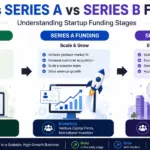
Series A generally focuses on building a scalable business model, while Series B is typically focused on accelerating growth and expanding an already established business.
Do all startups raise venture capital?
No. Many startups are bootstrapped or funded through customer revenue, loans, grants, angel investors, or other sources of capital. Some businesses never raise venture capital.
Does startup funding reduce founder ownership?
Usually, yes. When investors receive equity in exchange for capital, founders and existing shareholders experience some level of equity dilution.
Final Thoughts
Understanding startup funding stages gives founders a clearer roadmap for financing their businesses. Each stage represents a different point in a company’s journey, from validating an idea during the pre-seed stage to scaling internationally through later funding rounds.
The most important lesson is that fundraising should support business progress rather than become the ultimate goal. Founders who understand their capital requirements, track the right metrics, choose suitable investors, and use funding to reach meaningful milestones are better positioned to build sustainable companies.
Whether a startup is preparing for its first seed round or considering a Series A, Series B, or later funding round, knowing what investors expect at each stage can make the fundraising process more strategic and effective.
Also read : How to Create a Winning Pitch Deck: A Complete Guide for Startups and Entrepreneurs