

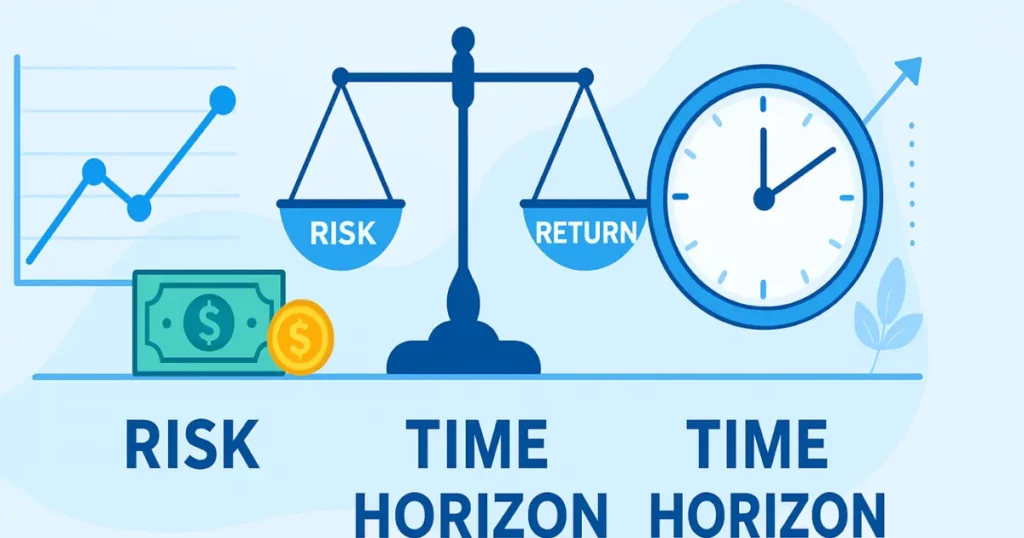
Risk, Return, and Time Horizon:Smart Investors — In the world of investing, one truth always stands firm—every financial decision comes with some level of risk, potential return, and a time horizon that shapes the outcome. Whether you’re a beginner trying to understand how investments work or someone looking to build long-term wealth, learning how these three core concepts interact is essential. They influence everything from your investment strategy and asset selection to how confidently you navigate market ups and downs. When investors understand the relationship between risk, return, and time horizon, they make better decisions, avoid emotional mistakes, and stay focused on long-term financial goals.
In this article, we will break down what risk means in investing, how returns are generated, why time horizon matters, and how all three work together to shape a balanced investment plan.
What Is Risk in Investing?
In simple terms, investment risk refers to the possibility of losing money or not earning the expected return. Every investment carries some degree of uncertainty—whether it’s stocks, bonds, mutual funds, real estate, or gold. The level of risk varies from asset to asset, and understanding this helps you choose investments that match your financial goals.
Types of Investment Risk
- Market Risk
The chance that the value of your investment will decrease due to market fluctuations. This is common in stocks and equity mutual funds. - Credit Risk
Mostly related to bonds; it is the risk that the issuer may default on payments. - Inflation Risk
When inflation rises, the real value of your money falls. Low-return investments like savings accounts often face this risk. - Liquidity Risk
The risk of not being able to convert an investment into cash quickly without losing value. - Interest Rate Risk
Common in fixed-income securities, where rising interest rates may decrease the value of existing bonds.
Understanding these risks helps investors build a portfolio that suits their financial stage and comfort level.
What Is Return in Investing?
Investment return refers to the profit or gain you earn from your investments. This can come in several forms:
- Capital Appreciation: Increase in the value of the asset (example: stock price rises).
- Dividends: Companies share part of their profits with shareholders.
- Interest Income: Earned from fixed-income products like bonds, FDs, or savings accounts.
- Rental Income: Earned from real estate investments.
Higher returns often come with higher risks, which leads to the important investing principle:
“Risk and return are directly related.”
The Risk-Return Trade-Off
Investors who take more risk typically expect higher returns. For example:
- Equity investments carry high risk but also offer high long-term returns.
- Bonds and fixed deposits have lower risk but also lower returns.
- Real estate falls in between but carries market, liquidity, and regulatory risks.
Understanding this trade-off helps you balance your portfolio depending on how much risk you can tolerate.
What Is Time Horizon in Investing?
Your time horizon refers to the length of time you plan to stay invested before needing the money. It plays a major role in choosing the right investments and determining how much risk you can take.
Types of Time Horizons
- Short-Term (0–3 years):
Best suited for safe investments because markets can be unpredictable in the short run.
Examples: Fixed deposits, liquid funds, high-quality short-term bonds. - Medium-Term (3–7 years):
Moderate risk investments are suitable.
Examples: Balanced mutual funds, debt-equity hybrid funds. - Long-Term (7+ years):
Ideal for high-growth investments.
Examples: Stocks, equity mutual funds, real estate, retirement funds.
Why Time Horizon Matters
A longer time horizon gives investments more time to recover from market fluctuations. This is why financial advisors often recommend equity investing for long-term goals like retirement, children’s education, or wealth creation.
How Risk, Return, and Time Horizon Work Together
To build a successful investment strategy, you must understand how risk, return, and time horizon are connected.
1. Higher Risk = Higher Potential Return (Over the Long Term)
Equity markets—although volatile—tend to offer higher returns to long-term investors. The longer your time horizon, the more risk you can take.
2. Short Time Horizon = Lower Risk Tolerance
If you need money in 1–2 years, taking high risks can be dangerous. A market downturn could reduce your capital.
3. Time Reduces Market Volatility
Historical data shows that the longer you stay invested, the lower your chances of losing money.
4. Goals Shape Your Time Horizon
Your financial goals determine whether you should invest aggressively, moderately, or conservatively.
5. Diversification Balances the Risk-Return Equation
Including different asset classes like stocks, bonds, gold, and real estate helps reduce overall portfolio risk.
Understanding Your Risk Profile
Before investing, it’s important to understand your risk tolerance, which depends on:
- Age
- Income stability
- Financial responsibilities
- Investment experience
- Emotional ability to handle losses
For example, a young investor with a stable job may tolerate higher risk than someone nearing retirement.
Types of Risk Profiles
- Conservative Investor:
Prefers safety over returns.
Investments: Bonds, FDs, low-risk mutual funds. - Moderate Investor:
Comfortable with some volatility.
Investments: Balanced funds, blue-chip stocks. - Aggressive Investor:
Willing to take high risks for high returns.
Investments: Equity funds, growth stocks, sector funds.
Building Your Investment Strategy Using Risk, Return, and Time Horizon
1. Set Clear Financial Goals
Example goals: buying a house, retirement planning, children’s education, starting a business.
2. Choose Investments Based on Time Horizon
- Short-term → Low-risk investments
- Long-term → High-growth investments
3. Diversify Your Portfolio
Don’t put all your money in one asset class. A balanced portfolio improves stability.
4. Invest Regularly
Use SIP (Systematic Investment Plan) to average out market volatility and build wealth over time.
5. Review and Rebalance Periodically
Your risk tolerance and goals may change over time. Adjust your investments accordingly.
Practical Example: How the Three Work Together
Imagine you want to build a corpus for retirement 25 years from now.
- Time Horizon: Long-term (25 years)
- Risk Tolerance: Moderate to high
- Suitable Investments: Equity mutual funds, index funds, NPS
- Expected Return: Higher long-term growth through equities
On the other hand, if you want to save money for a vacation next year:
- Time Horizon: Short-term (12 months)
- Risk Tolerance: Low
- Suitable Investments: Recurring deposits, liquid funds
- Expected Return: Low but stable
This shows how your goal and time horizon guide the risk and return expectations.
Conclusion: The Foundation of Smart Investing
Understanding risk, return, and time horizon is essential for making smart, confident investment decisions. These three elements form the foundation of every successful financial plan. Once you understand your risk profile, align it with your time horizon, and choose investments that match your expected returns, you create a balanced strategy that grows your wealth sustainably.
Remember:
- No investment is risk-free.
- Higher returns require time and discipline.
- Long-term investing reduces volatility.
- A diversified portfolio protects you from market uncertainty.
When you approach investing with clarity, patience, and strategy, you can achieve your financial goals and build long-lasting wealth.
Also read: What Is Investing and Why It Matters: A Complete Beginner’s Guide